
Achilles tendon pain is one of the most common injuries affecting runners. Research suggests around 6–10% of runners develop Achilles tendinopathy each year, particularly those increasing training load, returning after a break, or introducing faster running and hill sessions.
Although Achilles pain can be frustrating, modern sports medicine research shows that most runners do not need to completely stop running. With appropriate load management and progressive strengthening, runners can often continue training while the tendon recovers and regains capacity.
Achilles tendinopathy is a load-related tendon condition affecting the tendon that connects the calf muscles to the heel bone.
Historically this condition was called “tendonitis,” but modern research shows inflammation is usually not the main issue. Instead, the problem is a
mismatch between tendon load and tendon capacity.
When the tendon is exposed to more load than it can tolerate, symptoms such as the following can occur:
Pain in the back of the heel or lower calf
Morning stiffness
Pain during running or calf raises
Tenderness when pressing on the tendon
The good news is that tendons are highly adaptable and can improve significantly with the right rehabilitation.
In most runners, Achilles tendinopathy develops gradually due to training load changes combined with physical capacity limitations.
Common triggers include:
Increasing running distance too quickly
Adding hill running
Introducing speed sessions
Increasing running frequency
Reduced calf strength
The gastrocnemius and soleus muscles absorb large forces during running. Weakness or poor endurance in these muscles increases strain on the
tendon.
Weak big toe and foot muscles
The big toe contributes to propulsion during running. Reduced strength here can increase demand on the Achilles tendon.
Reduced hip stability
Weak hip stabilisers can alter running mechanics and increase load through the calf–Achilles complex.
Limited ankle mobility
Reduced ankle range of motion
Reduced ankle dorsiflexion can increase strain on the tendon during the stance phase of running — the part of the stride where the foot is on the
ground absorbing and generating force.
These factors often combine to create the load vs capacity mismatch that drives tendon pain.
Because Achilles tendinopathy is often linked to specific strength deficits, identifying these limitations is essential.
Assessment typically includes:
Calf strength and endurance
Soleus strength
Foot and toe strength
Hip stability
Ankle range of motion
Running load history
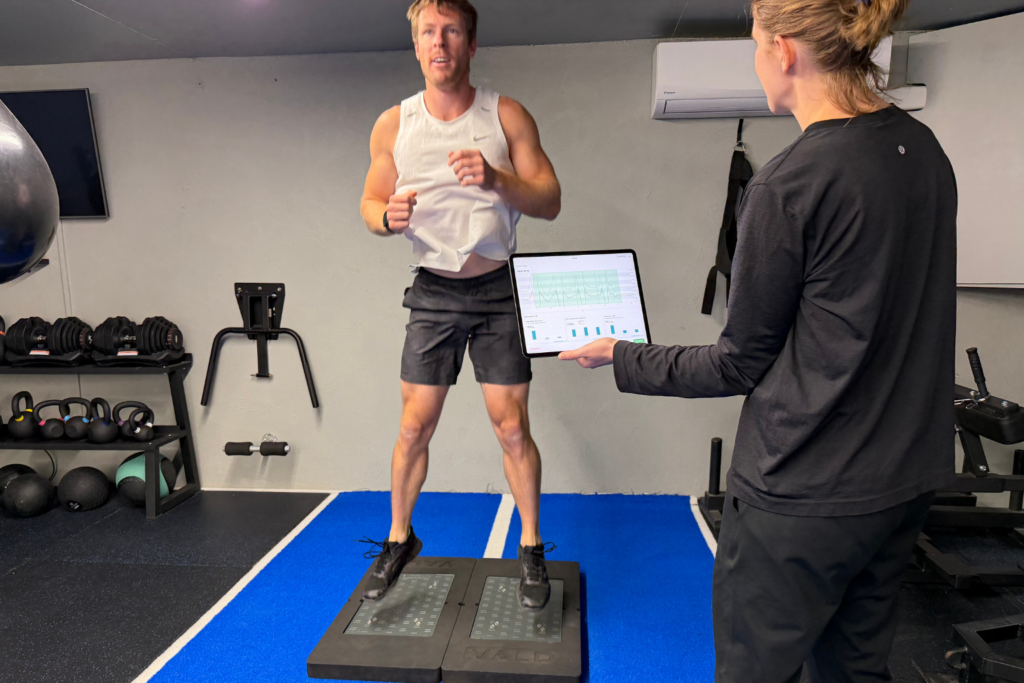
At Musculo Health & Performance we also use testing technology from VALD to objectively measure strength and asymmetry.
This helps identify deficits such as reduced calf force production or side-to-side differences so rehabilitation can be precisely targeted and tracked
over time.
Modern rehabilitation focuses on progressively improving the tendon’s load tolerance.
Early rehabilitation often uses isometric calf exercises to help reduce pain while safely loading the tendon.
Progression then moves to slow heavy calf strengthening, targeting both gastrocnemius and soleus muscles to improve tendon capacity.
Later rehabilitation introduces plyometric exercises such as hops to restore the tendon’s ability to store and release elastic energy during running.
Most runners can continue running during recovery with sensible load adjustments. This may include:
Reducing weekly running volume
Temporarily modifying hill running
Reducing speed work intensity or frequency
Importantly, speed work usually does not need to be eliminated completely, but it may need to be reduced while the tendon regains strength.
Although temporary load reduction may help symptoms settle, complete rest rarely resolves tendinopathy.
Rest does not address the underlying capacity issue and can lead to:
Reduced calf strength
Loss of tendon stiffness
General deconditioning
When running resumes, the tendon may be less prepared to tolerate load, which can worsen symptoms.
For this reason, modern rehabilitation focuses on maintaining appropriate tendon loading while progressively building strength.
If Achilles pain is limiting your running, the right assessment and rehabilitation plan can make a significant difference.
Book a physiotherapy appointment to assess strength, mobility, and tendon capacity.
At Musculo Health & Performance, we use objective strength testing and evidence-based rehabilitation to help runners reduce pain, restore tendon capacity, and return to running with confidence.