
Understanding the healing process and why the right physiotherapy at the right time matters
One of the most common questions people ask is:
“How long will this take to get better?”
The answer depends on the injury, your health, and how early treatment begins — but most musculoskeletal injuries follow a predictable healing timeline. Understanding these stages can help set realistic expectations and explain why physiotherapy often changes throughout recovery.
Pain improving does not always mean tissues have fully healed. In fact, many people stop treatment too early — often during the stage where tissues remain weak and reinjury risk is still high.
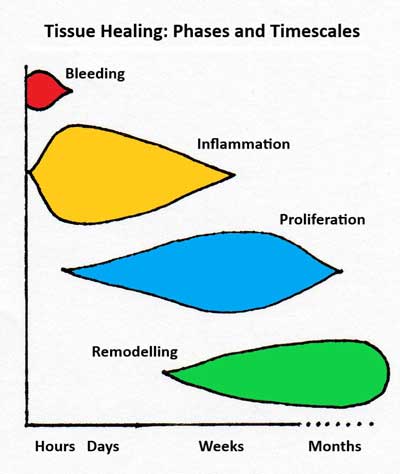
Phase 1: Bleeding and Inflammation
Typical timeframe: First few days to around 1–2 weeks
This is the body's immediate response to injury.
Following a muscle strain, ligament injury, tendon irritation, joint sprain, or flare-up of pain, tissues enter an inflammatory phase. During this stage there is often:
- Pain
- Swelling
- Reduced movement
- Difficulty walking or moving normally
- Restricted day-to-day function
- Difficulty sleeping
- Reduced work or sporting capacity
The inflammatory phase is often uncomfortable, but inflammation itself is not necessarily bad — it is part of normal healing.
At this stage, physiotherapy usually focuses on:
- Pain relief
- Reducing irritation and swelling
- Improving comfort
- Restoring early movement
- Helping you function day to day
Many people benefit from more frequent physiotherapy during this early stage — sometimes twice weekly depending on symptom severity.
This is often important not just for healing, but for sleeping more comfortably, functioning at work, managing pain during daily activities, and preventing excessive stiffness and guarding.
The goal is not simply to “rest and wait,” but to calm symptoms while beginning appropriate movement.
Phase 2: Proliferation
Typical timeframe: Around 1–6 weeks
This is the repair phase.
During proliferation, the body begins laying down scar tissue and new collagen fibres to repair the injured area. Symptoms often improve during this stage, and many people notice less pain, better movement, and improved day-to-day function.
However, this stage can be misleading. Although pain often settles, the healing tissue is still relatively weak and disorganised. This is where many people make the mistake of stopping physiotherapy too early.
Just because pain is improving does not mean the tissue is fully prepared for sport, heavy lifting, running, repetitive work, or higher training loads.
Physiotherapy during this stage usually shifts toward progressive strengthening, restoring range of motion, improving movement quality, and building tissue tolerance. Clients are often seen weekly during this phase to ensure loading progresses safely.
Phase 3: Remodelling and Strengthening
Typical timeframe: From around 3 weeks onward — often several months
This is the stage where tissue becomes stronger, more organised, and more resilient.
Pain is often minimal or absent, which can create the impression that recovery is complete. However, many tissues — particularly tendons, ligaments, and muscles — continue remodelling long after symptoms settle.
During this stage, physiotherapy focuses on strength training, power and control, movement retraining, return to sport or activity, injury prevention, and building long-term resilience.
This phase is often the difference between temporary symptom relief and lasting recovery. Without rebuilding strength and movement capacity, tissues may remain vulnerable and symptoms can return once normal activity resumes.
Why Regular Physiotherapy Matters
Physiotherapy should evolve as your body heals.
Early treatment focuses on helping you function and reducing pain. Later treatment focuses on restoring movement and progressively rebuilding tissue capacity.
Many people stop once symptoms improve, but the strongest long-term outcomes usually occur when rehabilitation continues through the strengthening and remodelling stages, rather than ending once pain settles.
Ready to Recover Properly — Not Just Temporarily?
If pain or injury is limiting your movement, work, training, or sleep, the right rehabilitation plan can help guide recovery and reduce the risk of recurrence.
Book a physiotherapy appointment to assess your injury and recovery stage.
At Musculo Health & Performance, we help you reduce pain, rebuild strength, and return confidently to the activities you enjoy.